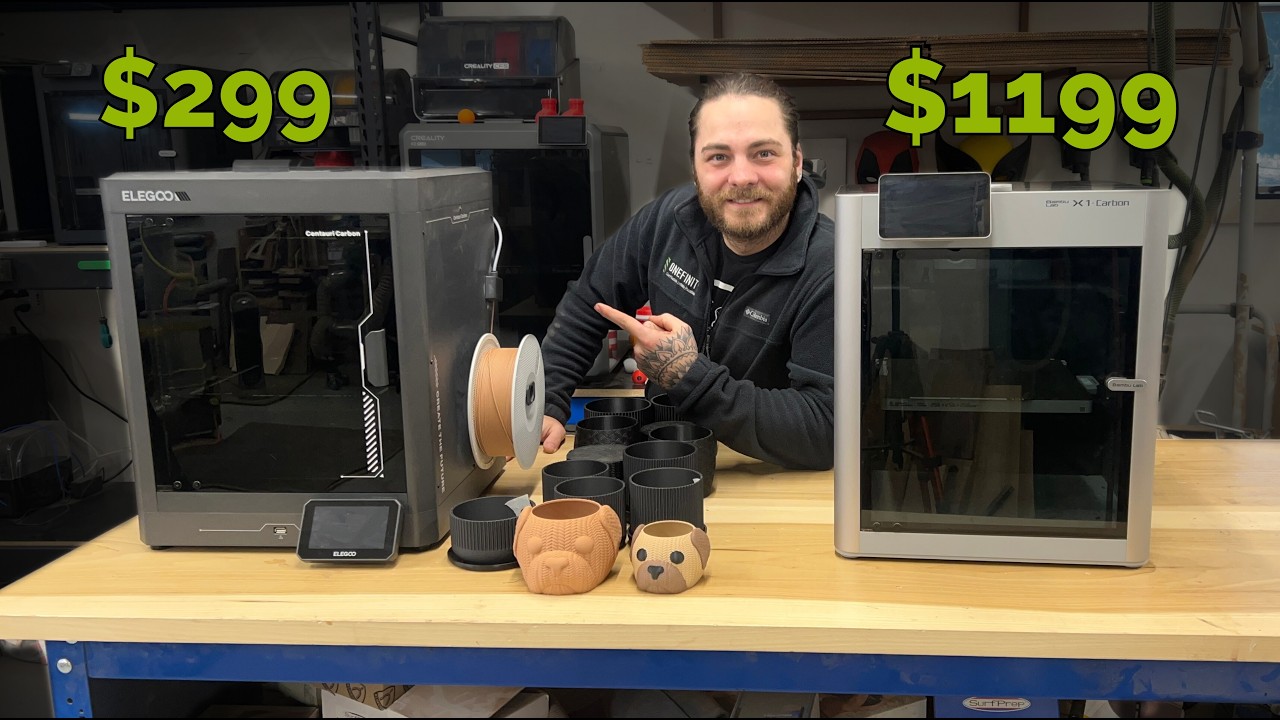
If you've been watching the 3D printer market, you know Bambu Lab set the bar for enclosed CoreXY machines. The Bambu X1C is excellent — and at $1,200, it had better be. The Elegoo Centauri landed at $300, promising similar features at a quarter of the price. So the obvious question: is it actually for real?
What You Get for Your Money
Both printers arrive as fully enclosed CoreXY machines with dual-sided magnetic build plates, onboard cameras, and purge buckets. On paper, the feature lists are nearly identical. The Centauri actually one-ups Bambu in a couple of quality-of-life spots: the filament input is mounted on the side rather than the back — a huge win if your machines sit against a wall. The USB port also sits right on the front panel, which is exactly where it belongs.
On the downside, the Centauri's interior lighting is genuinely bad. It's a single tiny LED that barely illuminates the chamber; a cheap LED strip would fix it in minutes. The cooling fan also runs noticeably louder when it kicks in. Neither issue is a dealbreaker, but they're polish details Bambu gets right that Elegoo hasn't nailed yet.
Real Print Quality: PLA, ABS, ASA, and PETG
Running the same files and same filament rolls on both machines, the results are closer than you'd expect. PLA and ABS prints are nearly indistinguishable side by side. The Centauri shows slightly worse VFA patterns (vibration-related surface ripples) on curved parts, and PETG came off with more stringing at stock settings — but both issues are fixable with basic tuning: lower temp, adjusted retraction. Out of the box, both machines produced solid, giftable results.
One clog happened in the Centauri's first 100 hours. Clearing it took about 10 minutes using a heated wire to pull the plug. The real pain is the hotend cable routing — reconnecting tiny plugs in a cramped space with normal-sized hands isn't fun. Elegoo should move those connectors somewhere more accessible.
Slicer and Ecosystem
Elegoo Studio, the bundled slicer, is essentially a clone of Orca Slicer — same layout, same workflow. If you've used Bambu Slicer or Orca before, you're comfortable in two minutes. Wi-Fi file transfer works cleanly on both machines.
The bigger story is ecosystem lock-in. Bambu pulls you into a closed platform: AMS multi-material units, cloud-dependent features, a proprietary workflow. The Centauri is more open — a plus if you eventually want to run Klipper or just prefer not being tied to one company's ecosystem.
The Verdict
At $300, the Elegoo Centauri is one of the strongest arguments against spending $1,200 on a 3D printer. Print quality is close enough that most people — including those printing parts for others — won't notice the gap. The Bambu X1C is still the more polished machine with a tighter, zero-hassle ecosystem. But if you want great prints at a fair price and don't mind dialing in a few settings, the Centauri absolutely delivers. For beginners especially, it's a remarkable deal.
This article was created with AI help. If you want to watch the original video, please visit the link below.