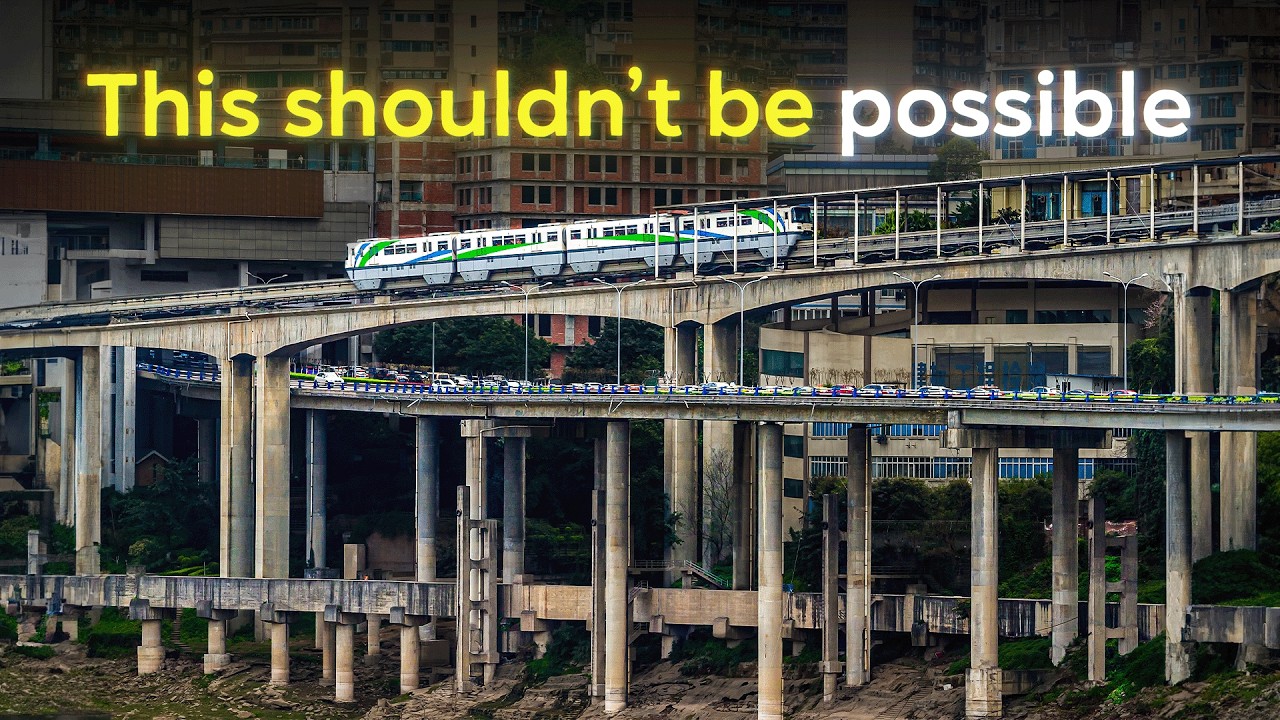
Most metro systems run underground, under streets, under your feet. Chongqing's metro runs through someone's living room floor — or close enough. Line 2 of the Chongqing Rail Transit passes directly through the sixth to eighth floors of a residential building. That's not a glitch in the planning. It was intentional. And it's just one of many reasons this is the most extreme metro system on the planet.
A City That Shouldn't Exist
Chongqing sits in southwest China, but it's nothing like the flat, sprawling cities you'd picture. The terrain is brutal — mountains slice through the city in long ridges, like fingers on a hand. The highest point is around 400 meters above sea level; the lowest is about 150 meters. That 250-meter difference means you could drop a skyscraper in the valley and the roof still wouldn't reach the hilltops.
Around 32 million people live here. For context, that's four times the population of New York City, crammed into a city that climbs, drops, and folds back on itself. Locals call it the "8D city." Getting around used to mean gridlock. By the late 1980s, Chongqing's roads were ranked among the worst in China.
Why They Chose Monorail
Standard metro design — flat steel rails, underground tunnels — wasn't going to work in a city this vertical. A conventional underground line costs upward of $200 million per kilometer to build. A monorail comes in around half that.
Monorails have other advantages in tough terrain. They're lighter, which means fewer support columns on elevated sections. They handle tight curves and steep grades better than conventional rail. And because so much of Chongqing's network runs elevated above the streets — over rivers, along cliff faces, between buildings — monorail made sense in ways it rarely does elsewhere.
The tradeoff: monorail takes up more vertical space, which makes tunneling expensive. So Chongqing ended up with a hybrid network. The first two lines are monorail; the remaining ten use conventional rail in deep tunnels, some of which required years of excavation through solid rock.
The Records This System Holds
The Chongqing metro doesn't just break one record — it holds a stack of them:
- Highest metro station in the world: Platform sits nearly 50 meters above street level.
- Deepest metro station in the world: Hongyancun station goes more than 100 meters underground. The escalator ride takes eight minutes. Your ears pop.
- Longest monorail line in the world: Line 3, completed in stages from 2011, with roughly 250 million rides per year — also the busiest monorail line on Earth.
- Longest metro-only suspension bridge: The Egongyan Rail Transit Bridge at 1.6 km.
- Highest metro-only bridge: The Caijia Rail Transit Bridge, 100 meters above the Jialing River. On foggy days, trains cross through the clouds.
Hongyancun (deepest) and Hualongqiao (highest) sit on the same line, just a few stops apart.
The Train That Goes Through a Building
The most photographed feature of the whole system is Line 2 passing through Liziba station — which is built into floors six through eight of a residential tower. The building was being planned when the metro line was routed. Rather than demolish the project or reroute the line, engineers designed the building around the train.
To prevent vibration damage, the construction team placed the monorail pillars inside wide vertical tubes embedded in the building's structure. The tubes are oversized so the pillars never make contact with the walls, even when the train passes. Inside the apartments, noise from the train runs at around 60 decibels — comparable to a running dishwasher. Residents knew what they were signing up for.
What's Coming Next
Chongqing currently runs 12 rail lines covering 560 kilometers — longer than either the New York subway or the London Underground. Three more lines are under active construction, and the city's transport plan calls for 23 lines total by 2035.
Whether future lines will set more records is anyone's guess. But given what Chongqing has already built — through mountains, over rivers, and straight through apartment blocks — it would be unwise to bet against them.
This article was created with AI help. If you want to watch the original video, please visit the link below.