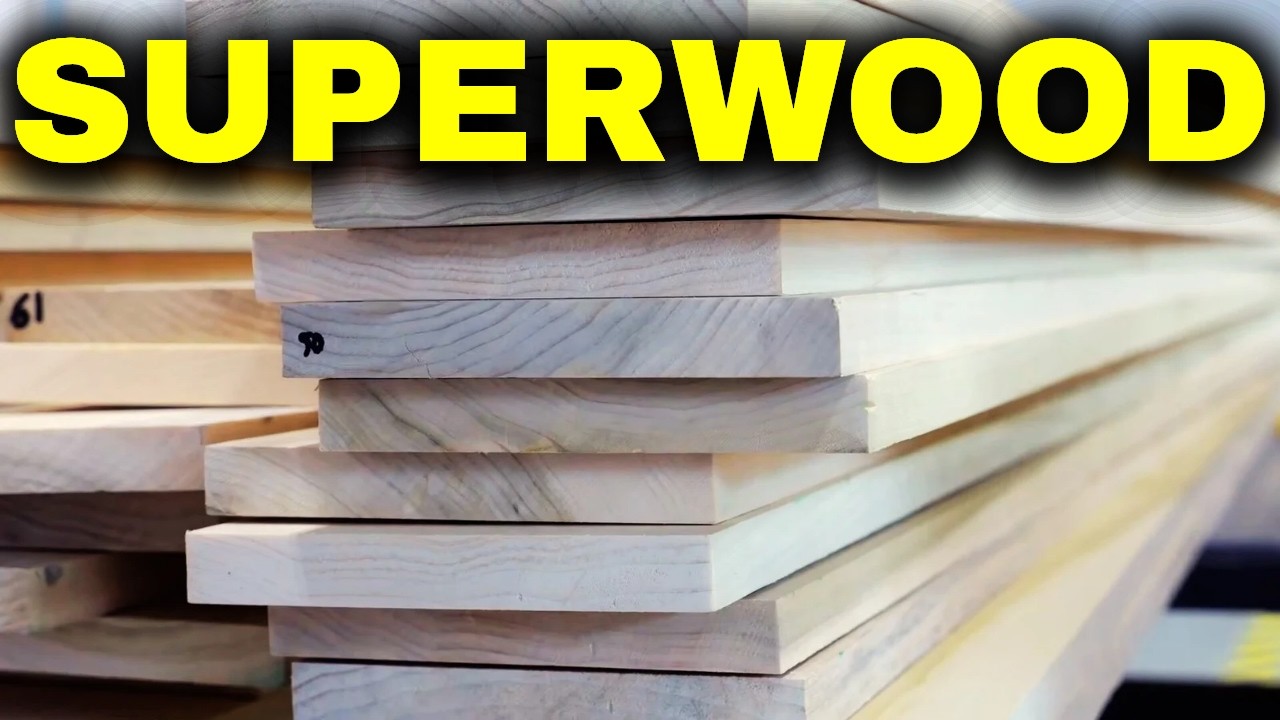
Wood that stops bullets, resists termites, and outperforms steel sounds like science fiction. Superwood is real, it's made from ordinary lumber, and a US company called InventWood is ramping up commercial production right now. Here's what you actually need to know.
What Superwood Is and How It's Made
Regular wood is made up of three main components: cellulose (the structural fiber, 40–50%), hemicellulose (a similar but different sugar-based material, 20–30%), and lignin, which acts as a binder holding it all together.
To make superwood, manufacturers first boil the wood in a solution of sodium hydroxide and sodium sulfide. This partially strips out the lignin and hemicellulose while leaving the cellulose mostly intact. Then the treated wood is compressed under heat until its cell walls collapse and the cellulose nanofibers bond together chemically. The result: a material that's lighter than steel and roughly twice as strong.
The Company Behind It
InventWood — based in Maryland — has raised $50 million in capital and is beginning commercial production this summer. Their CEO, Alex Liao, confirmed they're currently using poplar, a fast-growing hardwood that's abundant near their plant. Going forward, they plan to use whatever wood makes sense locally — pine and spruce in the US, bamboo in Asia. They can even use low-grade timber from forest fires, diseased trees, or beetle-kill wood that traditional lumber mills pass on.
Termites, Water, and Durability — The Real Questions
Termites: InventWood tested superwood at a US Forest Service lab alongside regular wood. The insects ignored the superwood and ate the regular wood instead. When placed with only superwood, some termites tried to eat it but couldn't penetrate the density and eventually died.
Water: Superwood is still hygroscopic — it absorbs and releases moisture like any wood — but far less so than untreated lumber because the fibers are compressed. It swells less, moves less seasonally, and InventWood has treatments that impregnate the wood with water-resistant substances throughout — not just on the surface. This matters because one of their first products is designed for exterior use.
Cutting, Fastening, and Working With It
You don't need exotic tools, but you do need to upgrade a few things. Carbide blades are required for cutting. Screws need pre-drilled holes — skip that and they'll bounce off. High-pressure nailers work fine for single-layer pieces. Glues and adhesives are also compatible with proper surface coatings.
What It Costs and Where It Makes Sense
Don't expect this at Home Depot pricing any time soon. A regular fence picket runs about $3. The equivalent in superwood costs roughly five times that — for the wood alone, before any additional processing. Liao compares their go-to-market strategy to Tesla's early Roadster: start with premium applications that show off the material's strengths, then scale down in price as adoption grows.
The best applications play to its unique properties: fire-resistant decking and fencing (critical given California's wildfire rebuilding), structural beams, and exterior cladding where strength and aesthetics both matter. Making knives out of it? Technically possible. Practically a novelty.
The Bottom Line
Superwood isn't a replacement for lumber at the hardware store — it's a replacement for steel and concrete in specific high-value applications. Fire-resistant, termite-resistant, renewable, and genuinely stronger than steel by weight, it has real potential in construction and exterior building products. Pricing will limit early adoption to projects where performance justifies the premium, but the material is legitimate, the company is funded, and production starts this summer.
This article was created with AI help. If you want to watch the original video, please visit the link below.