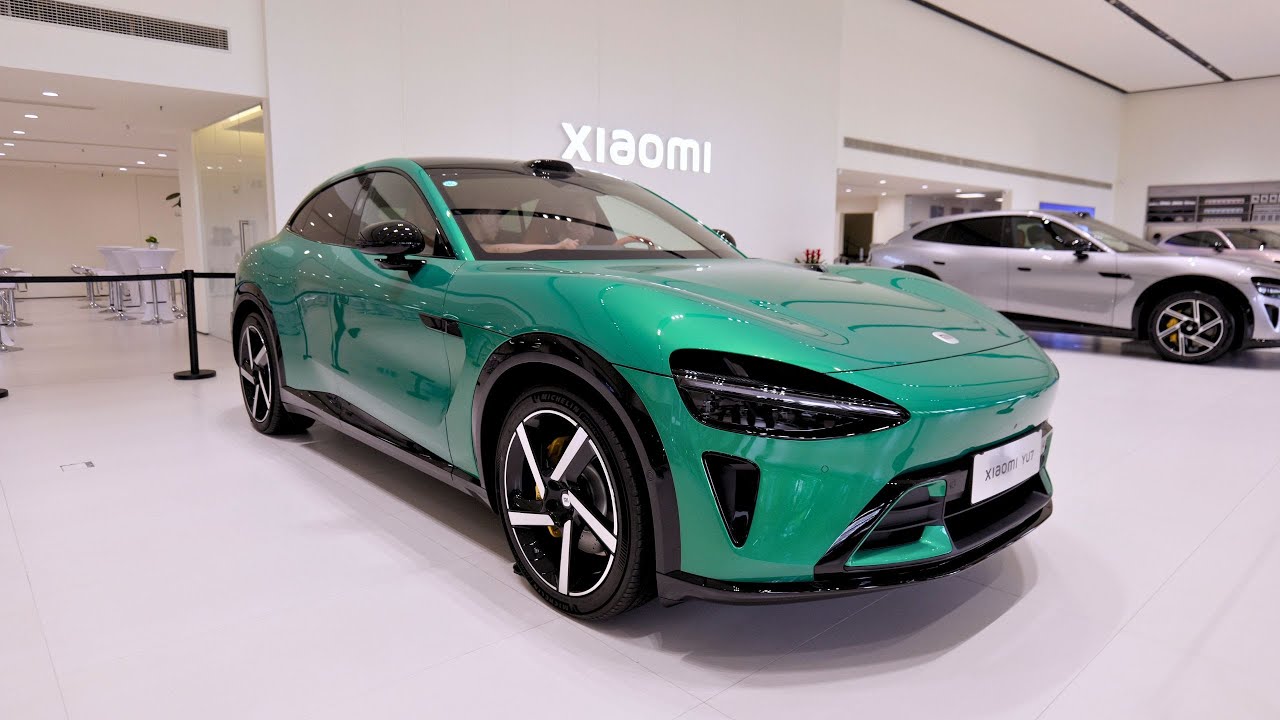
Xiaomi's SU7 sedan proved the brand could build a serious EV. The Xiaomi YU7 is the follow-up SUV — and the pre-order numbers alone are jaw-dropping: over 200,000 orders came in within three minutes of the launch event ending. The deposit retention rate is reportedly triple that of the SU7. Whether or not those figures hold up, the car has people's attention. Here's what a hands-on first look and a short test drive actually revealed.
Design: Big, Sharp, and Built Around Aerodynamics
At just under 5 meters long but only 1.6 meters tall, the YU7 is a large SUV that sits low. It's longer than a Tesla Model Y but matches it in height — giving it a crouched, athletic stance. The front end is wide and pointed, with cross-shaped headlights that double as aerodynamic air tunnels, letting airflow pass through rather than around them. Air channels also run near all four wheel arches.
The frunk (front trunk) holds 141 liters — enough to swallow a 24-inch suitcase with room to spare. That's a practical number. The rear trunk is a different story: it's smaller than you'd expect on a 5-meter car because Xiaomi prioritized the swept roofline over cargo volume. There's a sub-trunk underneath for tools and overflow items.
Interior: Tech-Forward, With One Headline Feature
The YU7's standout party trick is its Hypervision HUD. Three mini-LED screens sit at the base of the windscreen and project navigation, speed, and driving data directly onto the glass — not as a faint reflection like traditional HUD systems, but as crisp, high-contrast graphics. The black backing makes them pop, and the display is visible to front passengers, not just the driver. Xiaomi claims to be the first automaker shipping this tech in production; BMW has announced plans, but hasn't launched it yet.
Front seats offer massage, ventilation, heating, and zero-gravity recline — they fold fully flat. The rear seats get heating and a 135-degree recline, which is good but not as generous as the front. Despite the car's size, rear legroom is roughly on par with the Model Y — the design trade-off is real and worth knowing before you buy.
The rear cabin comes loaded: a detachable tablet-style screen for controlling climate and media, a mini fridge, two USB-C ports, and a 180W + 12V outlet in the trunk. Xiaomi phone users also get hands-free door handles that extend automatically on approach.
Ride and Handling: Where It Actually Delivers
All YU7 variants ship with CDC adaptive dampers as standard. The Pro and Max add dual-chamber air suspension. On the short test drive in the video, the Max model felt noticeably smoother than the SU7, absorbing road imperfections without going soft. High-speed cornering roll control was described as better than both the SU7 and the Tesla Model Y — a notable benchmark to beat.
Wind noise at 80 km/h was well-controlled, with only slight sound near the roofline. Braking and acceleration were smooth across Sport and Comfort drive modes, with different sensitivity profiles for each.
Specs to Know
- Length: ~5 meters
- Height: ~1.6 meters (same as Tesla Model Y)
- Front trunk: 141L
- Wheels: 19", 20", or 21" options
- Suspension: CDC adaptive dampers (all); dual-chamber air (Pro/Max)
- Front seats: Zero-gravity recline, massage, ventilation, heating
- Rear seats: Heating, 135° recline
- HUD: Hypervision mini-LED windscreen projection
- Rear power: 180W AC + 12V outlet
Should You Care?
If you're cross-shopping in the larger electric SUV space and Xiaomi's ecosystem has any appeal, the YU7 looks like a genuine contender — not just a brand exercise. The Hypervision HUD is a real differentiator, the suspension tuning impressed in early testing, and the frunk is actually useful. The rear space compromise and smaller-than-expected trunk are honest trade-offs for the sleek roofline. A deeper long-range test drive will tell us more, but the first look suggests Xiaomi has built something Tesla should take seriously.
This article was created with AI help. If you want to watch the original video, please visit the link below.